
The common assumption is that the particular floor, minimum wage, forces the price of labor higher than equilibrium. This theory is widely accepted with anecdotal evidence of mom and pop stores forced to close when municipal laws force the wage higher. If the anecdotal evidence was indicative of market forces as a response to the wage we’d see a general economic decline. On top of a rise in inflation, as more people are forced out of work with wagesforced higher, local economies would be plunged into a death spiral. This has a lot of big names in economics going ballistic: 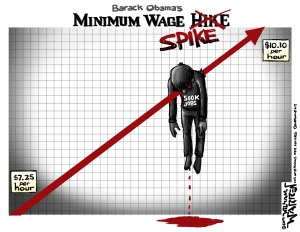 http://www.forbes.com/sites/jamesdorn/2013/05/07/the-minimum-wage-delusion-and-the-death-of-common-sense/, imagining a shark tank for jobs, and all the hipsters having to board up their coffee shops and burn their Kindles for warmth as everything collapses around them.
But this isn’t happening, as shown from San Francisco’s research into the effects of the minimum wage increase in 2003: http://sfcontroller.org/Modules/ShowDocument.aspx?documentid=5495. What is happening instead, illustrated by examples from Washington and California as they adopt higher minimum wages, is economies not only avoid going into decline, they actually start to thrive on a scale not seen by typical economic mandates. In short, raising the wage seems to have added jobs, not forced down the job market.
So what is happening? More people are being employed due to a rise in low labor wage? But weren’t stores supposed to close? The part on inflation is easy: When you consider the typical employer paying minimum wage, wages are only a small fraction of the cost to do business. Therefore the increase in fixed cost of doing business (wages for service jobs being a fixed cost – cost of keeping the door open, wages are only a marginal cost for manufacturing) is dwarfed if the local economy sees a sudden increase in consumer spending, and the consumers that spend the largest portion of their income are the ones at the lowest bracket of earnings – the minimum wage earners.
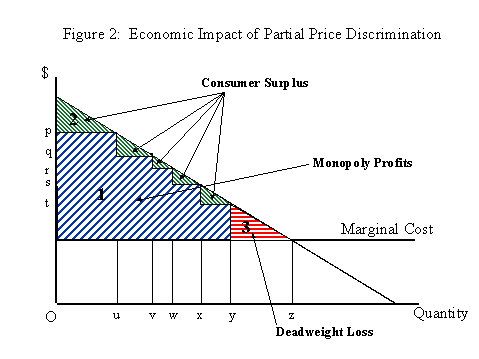
The other change is that the minimum wage market doesn’t function like the typical wage market. Minimum wage employment is a buyer’s market. The employer gets to decide who to hire, and who to let go. This means there is no negotiation in terms of wage. For skilled jobs that are significantly higher than minimum wage, there is a market force that leads to job wage equilibrium. Low wage jobs, the employer can be so discriminatory that they can participate in something called “price discrimination.” http://www.economicsonline.co.uk/Business_economics/Price_discrimination.html
Price discrimination is bad, long story short. Short story long: When prices are set to an equilibrium price, it means that there are people who value the “for sale” item highly, and some that value it lowly, and some in between, but there is ultimately one price. With this continuum, it means that all people who bought the item at a lower price than they actually valued it gain “utility” or got a super deal, which is good for the economy. With price discrimination, the seller can price the item more closely to what the buyer is willing to pay. Hence, all utility goes to the seller, not to the buyers. This forces a shift in wealth to the seller, which adds to income inequality, which breaks down the economy.
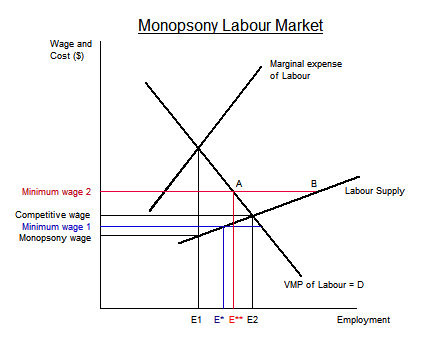
There is also a talk of Monopsony (like a Monopoly only for buyers), however, monopsony applies for sinlge buying situations, where the minimum wage market has many buyers, all at the same wage, making the arguement a weak one. http://www.economicthought.net/blog/2013/11/monopsony-and-minimum-wage-logic/ Monopsony would only occur if there was one buyer –minimum wage workers, however, are a large group going to many employers.
To better understand where price discrimination fits in, we have to imagine what happens when people are living below poverty, more specifically, what happens when people live below autonomous expenditure. People’s lives have costs; just living in the world has a cost associated with it. The bare minimum you have to pay out to survive is referred to as “autonomous expenditure,” the automatic payment that has to be doled out before you can consider buying goods or saving for a rainy day. The funny thing about autonomous expenditure is that this is stuff that is paid whether it is you footing the bill or not. http://en.wikipedia.org/wiki/Autonomous_consumption.
Autonomous expenditure is like the minimum cost of living. Except there is no law saying you have to make the minimum cost of living to live in a community. Instead, this is the toll an individual puts on their environment, if they are unable to make a living. Power bill may not get paid, but power is still delivered and served, and if enough payments are missed, the line must be additionally served to guarantee that individual is not free loading off other people’s power. Food needs to be eaten by that individual, but if they can’t afford it, are we so daft as to believe they’ll just sit in a corner thinking to themselves, “Shoot, I guess I do not get my bread this evening, maybe tomorrow. Instead, I will gaze at those enjoying the fruits of life.” Where people are living below poverty, delinquency, theft and scofflaw activities thrive. All of these drive down the GDP of the surrounding group, surprisingly equal to their autonomous expenditure.
Therefore, with poverty wages, employers can hire employees equal to their willingness to live below poverty, which in my view, is price discrimination. Employers get to set the price for those willing to live under their cost of living.
So why would economies boom with a rise in minimum wage? Well the cost of the labor has not changed. Willing to bet the $15 minimum wage will not meet those individuals minimum cost of living, especially if they have children. That being said, the bill for that cost is now coming from those paying the wages and not the surrounding communities. That mixed with a healthy dose of marginal propensity to consume (to be discussed later), giving the poor workers of America a decent wage ends up being cheaper than forcing them to steal it.
 Politically Skewed